




How to Make Your Camper Off-Grid Ready
Published Date: September 9, 2026
By Shalee
There's a moment every truck camper owner chases: the one where you're parked somewhere with no cell signal, no neighbors, and no idea when you'll plug into shore power again. Getting there takes more than just a good camper and a capable truck. It takes a rig that's actually set up to handle days (or weeks!) away from civilization.
We've spent over 50 years building campers meant to get people off the beaten path, and along the way we've learned what separates a camper that can technically go off-grid from one that's actually ready for it. Here's what to think through if you want your rig truly self-sufficient.

1. Start With the Right Camper
Before you get into solar panels and water tanks, the camper itself has to be built for the mission. An off-grid truck camper needs to be light enough that your truck can carry it comfortably with a full load of water, fuel, and gear, and rugged enough to handle the rough roads that usually lead to the best campsites.
This is where pop up campers have a real advantage. A lightweight truck camper keeps more of your truck's payload available for water, batteries, and supplies instead of eating it all up with the camper's own base weight. Our campers starting weights run from around 375 lbs for the Project M topper up through 1,300 lbs for the Grandby, which leaves real room to build out a proper off-grid setup on a half-ton or midsize truck.
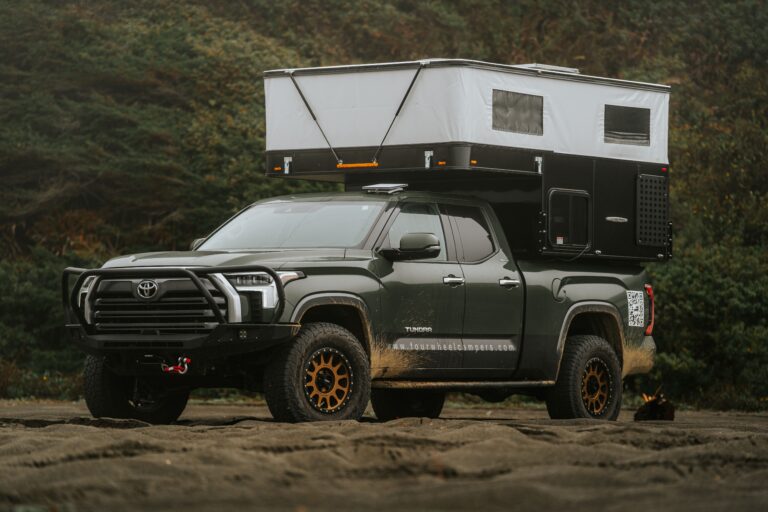
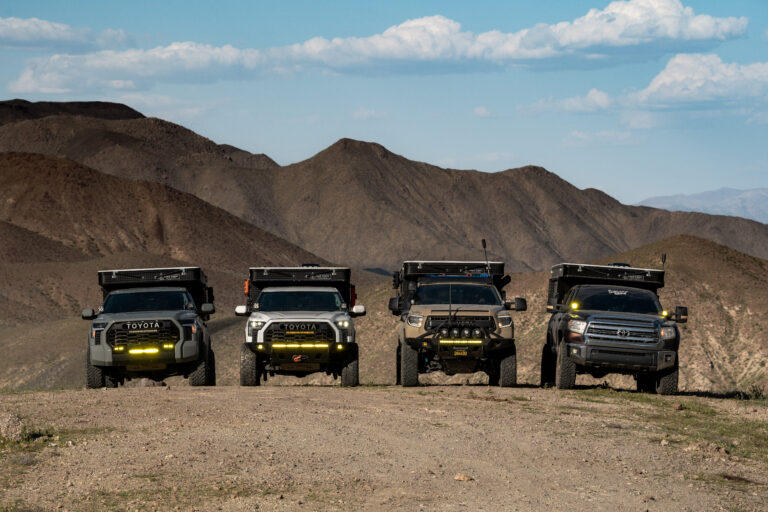
It also matters what truck you're building around. A Toyota truck camper setup, whether that's a Tacoma or a Tundra, is one of the most popular combinations in the overlanding world for good reason. Toyotas are known for reliability in remote conditions, and paired with a 4×4 truck camper built to stay light, you end up with a rig that can actually reach the places worth reaching. Not sure which model fits your specific truck? Our online truck selector tool will match you with the right camper based on your make, model, and bed length.
2. Build Real Power Capacity
Power is usually the first thing people think about when they picture going off-grid, and for good reason. Once you're away from hookups, your battery system runs everything, from your lights to your fridge, water pump, fans, and other devices.
One of the biggest mistakes people make is underestimating their power capacity!
The key is matching your power system to how you actually camp. Overbuilding costs weight and money, but underbuilding means you're rationing power by day three. With our truck camper build tool, you can easily customize your power capacity and solar for your truck camper.
A solid off-grid electrical setup includes:
- Lithium batteries. Lithium batteries charge faster, last longer, and can be discharged more deeply than older lead acid batteries, which means more usable power in a smaller, lighter package.
- Solar panels. Rooftop solar keeps your batteries topped off during the day without running a generator or your truck's engine. Most campers can support anywhere from 160 to 500 watts, and dedicated off-grid builds often go higher.
- An inverter. This converts your battery's DC power into standard AC power so you can run laptops, camera chargers, and other household electronics.
- Enough amp hours to actually last. A weekend trip and a three week off-grid stint require very different power budgets. Our Hawk+ model, for example, is built specifically for extended off-grid living, with up to 800Ah of power capacity, well beyond what a standard weekend camper needs.
3. Plan Your Water System Around Real Usage
Water is the resource that runs out the quickest on an off-grid trip, and trust us when we say it’s never something you want to have to ration. Standard truck campers typically carry around 20 gallons of fresh water, which is plenty for a long weekend of careful use. If you're planning trips that stretch into weeks, that math changes fast.
This is exactly why we built the Hawk+ with 40 gallons of fresh water, double our standard capacity, along with a dedicated 5 gallon gray water tank so you're not dumping wash water wherever you happen to park. A larger water capacity means fewer resupply stops and more flexibility about where you camp, since you're not tied to being near a fill station every few days.
A few habits make any water system go further:
- Use a water filter or purifier so you can top off from natural sources in a pinch
- Install a low flow shower head and faucet to stretch your supply
- Keep a mental (or literal) log of daily usage so you're not caught short on a longer trip
4. Rethink Storage and Cooking
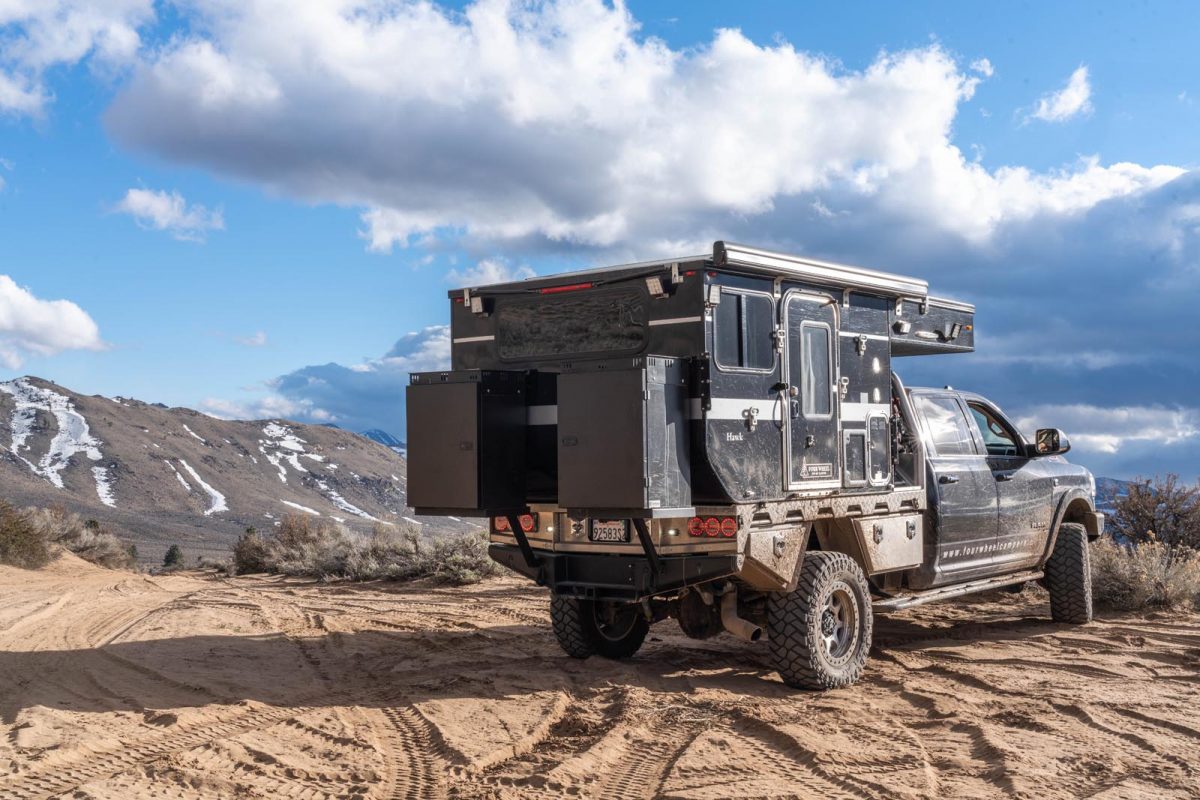
Off-grid trips mean carrying more of everything: food, tools, recovery gear, spare parts, and clothing for changing conditions. Most Four Wheel Camper models come with a built in propane stove, which means you're not dependent on a campfire, and fire restrictions won't leave you without a hot meal. Pair that with a way to store enough propane and non-perishable food for your trip length, and cooking off-grid becomes simple rather than stressful.
We recommend taking a couple of test weekend camping trips, so you know what kind of meals are your go-to camp favorites, and what you actually need to pack when it comes to spices, meals, and extras.
5. Make Sure Your Truck Can Handle It
An off-grid setup is only as good as the truck underneath it. Before loading up water, batteries, and gear, check your truck's payload capacity, which you'll find on the sticker inside the driver's door jamb. Add up your camper's dry weight, a full load of water and propane, your power system, and everything you plan to carry, and make sure it comes in comfortably under that number, not right at the edge of it.
This is where a lightweight truck camper really pays off. Because our campers weigh a fraction of a traditional hard side camper, you have more payload headroom left over for the batteries, water, and gear that make off-grid travel possible in the first place. It's part of why a 4×4 truck camper built around a pop up design, rather than a heavy hard side box, tends to be the better choice for serious backcountry travel.

6. Don't Forget Communication and Navigation
Being off-grid usually means being off cell service too, which means your usual navigation and communication tools won't work when you need them most. A satellite communicator like the Garmin GPS, lets you check in, get weather updates, and call for help in a genuine emergency, even with zero bars. Offline maps, whether through a dedicated GPS unit or a downloaded map app, are worth having as a backup to cell based navigation, especially on unfamiliar forest roads or desert tracks.
It's also smart to let someone know your general route and expected return, especially for solo trips or truly remote stretches. None of this is complicated, but it's easy to overlook until you actually need it.
7. Bring the Right Recovery Gear
Rough roads are part of the reward when it comes to off-grid camping, but they come with real risk of getting stuck. A basic recovery kit, traction boards, a shovel, a tire deflator and compressor, and tow straps, takes up relatively little space and weight, and it's the difference between a minor delay and a serious problem when you're miles from help.
8. Putting It All Together
Getting truly off-grid ready isn't about any single upgrade, it's about building a system where the camper, the truck, the power, the water, and the gear all work together for the trips you plan to take. Start with a lightweight, capable camper that doesn't eat up your truck's payload, add the power and water capacity that actually matches how you camp, and round it out with the storage, cooking, communication, and recovery gear that let you handle whatever the trip throws at you.
If you're building toward serious off-grid travel, take a look at our Hawk+ model, purpose built with the water, power, and storage capacity for extended stays off the beaten path. Use our Build & Price tool to spec out your ideal setup, or find a dealer near you to see it in person. And if you're still deciding what camper fits your truck and your goals, our team is always happy to help you figure out the right setup.

Common FAQs About Off-Grid Camping in Your Four Wheel Camper
How much solar do I need for off-grid camping?
Depends! We offer 160, 250, or 500w of solar for our truck campers. The more you plan to be off-grid, the more solar we recommend adding to your truck camper. But it’s important to know that solar only takes you so far without the right battery capacity. If you want more solar for your off-grid camper setup, try adding supplemental portable solar, which allows you to park in the shade but still have the benefit of solar. All our campers come standard with accessory solar plugs.
How many amp hours do I need for a truck camper?
Here at Four Wheel Campers, we currently offer 1 or 2 132ah (for some configurations), 1 or 2 162ah (for most configurations). Most people do not need more than 2 batteries for standard use.
How long can you realistically stay off-grid in a truck camper?
It depends entirely on your water, power, and food supply, not the camper itself. With a standard 20 gallon water tank and careful use, most campers are comfortable for 4 to 7 days. With a larger tank, like the Hawk+'s 40 gallons, or a resupply plan, trips easily stretch into two or three weeks. Power is rarely the limiting factor if you have adequate solar, since it can regenerate daily, while water and food are finite resources you're carrying with you.
Do I need a generator if I already have solar?
Most people don't, as long as their solar and battery capacity are sized correctly for how they camp. Solar with a properly sized lithium battery bank covers the vast majority of off-grid trips without needing a backup generator. A generator can still be useful as insurance for extended stretches of cloudy weather or heavier power draws, but it adds weight, noise, and fuel to carry, which runs counter to the point of a lightweight off-grid setup in the first place.
How much water should I plan for per person, per day, when camping off-grid?
A good baseline is 1 to 2 gallons per person per day, covering drinking, cooking, and basic hygiene. Hot climates, higher elevation, and more strenuous activity all push that number higher, so it's smart to plan on the higher end for desert or high altitude trips. A standard 20 gallon tank comfortably covers two people for about a week at that rate, while a larger tank like the Hawk+'s 40 gallons roughly doubles that runway.