
500W Roof-Mounted Solar
Four 125W panels that keep your batteries topped off on longer off-grid trips. Best for travelers who spend several days away from hookups. Trade-off: it is the heaviest solar option and adds cost
~25 lbs

Slides into truck bed

Our slide-in pop up camper that started it all. Over 50 years of fine tuning & perfecting have made this our most popular camper decade after decade.
Bolts to bed rails

A lightweight truck topper with camping capabilities. The Project M allows you to have full use of your truck bed, while having a pop-up camper.
Remove bed & apply

Maximize your adventures with our flatbed camper and Norweld Tray. More spacious and more storage for all of your gear.
Four Wheel Campers makes five pop-up campers that fit a Toyota Tundra, from a 390-pound topper to a fully built slide-in with a kitchen, furnace option, and queen bed. Every one keeps your Tundra’s low profile and off-road clearance, so you can go where an RV can’t.
The Tundra is one of the most popular full-size trucks we build for, and getting the fit right matters. Your bed length determines which models fit, and your payload determines which ones you should actually put on your truck.

Five models are built for full-size trucks like the Tundra. Which one is right depends on your bed length, your payload, and how much camper you want.
| Model | Fits | Base dry weight | Starting price | Best for |
|---|---|---|---|---|

Project M
Topper (bolts to bed rails)
|
All Tundra beds: 5.5', 6.5', and 8' | ~390 – 465 lbs | From $12,900 | Lightest build for your Tundra. Keeps the truck bed usable. A blank canvas you finish yourself. |

Raven
Slide-in pop-up
|
5.5' beds | ~1,050 lbs | From $20,275 | Short-bed Tundras that want a full built-out interior without a long bed. |

Hawk
Slide-in pop-up
|
6.5' beds | ~1200 lbs | From $20,800 | Our most popular full-size build, and the natural fit for the standard Tundra bed. |

Grandby
Slide-in pop-up
|
8' beds | ~1,300 lbs | From $21,850 | Long-bed Tundras that want the most interior space we offer in a slide-in. |

CampOut
Modular slide-in
|
5.5', 6.5', and 8' beds | ~950 – 1,050 lbs | From $24,450 | Tundra owners who want to configure modular components instead of a fixed layout. |
Weights shown are base dry weights. Your built camper will weigh more once you add options, water, propane, and gear.
See the Hawk, Raven, Grandby, CampOut, and Project M in person at a Four Wheel Campers dealer. Bring your Tundra for a fit check, and our dealer team will handle your install, which they do every week.
Find a Dealer Near YouEvery number on this page is a general reference for planning only. Payload varies significantly by model year, cab configuration, drivetrain, trim, and factory options: two Tacomas parked next to each other can differ by hundreds of pounds. Only the sticker on your truck tells you your truck’s rating.
The 2026 Tundra’s maximum payload is listed at 1,940 lbs, and that figure applies to standard-bed SR and SR5 models. Many configurations land lower, depending on cab, bed, drivetrain, and trim.
Use this range for orientation only. Your sticker is the only number that counts.
Choose your truck and bed length.
Pick the camper and layout that fit how you travel.
Add the options you want, keeping an eye on total weight.
Take your build to a dealer for a quote and installation.
A Tundra has more payload room than a mid-size truck, so larger solar arrays and roof storage are popular here. Every option adds weight, so we list it on each card.
Four 125W panels that keep your batteries topped off on longer off-grid trips. Best for travelers who spend several days away from hookups. Trade-off: it is the heaviest solar option and adds cost

A full roof rack for kayaks, bikes, boards, and gear boxes. Best for adventurers who need to carry more than the bed allows. Trade-off: roof weight affects how easily the roof lifts, so keep roof loads light.

A lithium battery system to run lights, fans, and charging. Best for anyone camping off-grid. Trade-off: it is one of the heavier electrical add-ons.

A quilted liner that insulates the pop-up fabric, with optional lower window coverings. Warmer in cold weather and darker in the morning. It stays on year-round and the roof still raises and lowers normally.

Shade and rain cover for your camp kitchen or seating area. Best for hot, sunny, or wet climates. Trade-off: it is a heavy option for its size.
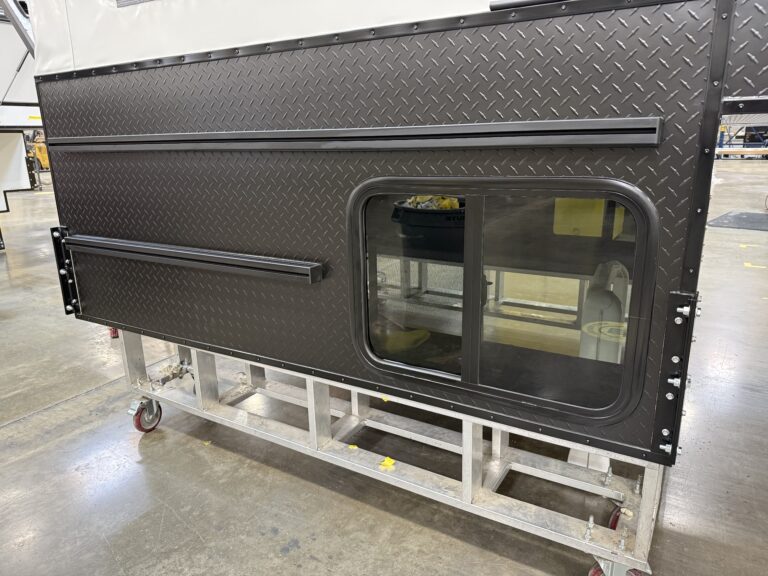
Mounting rails along the outside of the camper for bikes, fuel cans, and recovery gear. Available on the driver side, passenger side, or both. Trade-off: gear on the outside adds weight at the rear of the truck.

Recovery boards mounted on your gear tracks so they are ready when you need them. Best for off-road travelers. Trade-off: they add noticeable weight and require gear tracks.

A powered vent fan for airflow and condensation control. Available in two locations. Best for hot weather and cooking inside.
Add-on spec sheet PDF
Starting prices are the entry point, not the number most people pay. Here’s a more honest picture.
| Cost | Project M | Raven | Hawk | Grandby | CampOut |
|---|---|---|---|---|---|
| Starting price | From $12,900 | From $20,275 | From $20,800 | From $21,850 | From $24,450 |
Configure with a dealer or through Build & Price, place your deposit, and get a build slot.
Currently around 3–5 months, varying by dealer and season. Confirm the current estimate with your dealer before planning around a trip.
Your dealer installs the camper on your Tundra, including the tie-down system. If you’re having suspension work done, schedule it for the same visit so you drive away with a fully sorted truck.
Before you leave, you’ll be shown the lift system, heater, water system, electrical, and maintenance schedule. Ask every question you have — this is the time.
What impressed us most, however, was the efficient use of space. Every inch is thoughtfully used.
For most Tundra owners, it’s the Hawk. It’s our best-selling full-size camper and was built for 6.5-foot beds, with three floorplans and room for a kitchen, dinette, and queen bed. If you want more flexibility, the CampOut lets you add modules over time. If you want the lightest option and your full truck bed back, look at the Project M.
Many Tundras can, as long as the fully built camper plus everything you load stays under your truck’s payload. Our full-size slide-ins run about 1,050 to 1,300 lbs dry, and water, propane, gear, and passengers all count against your payload. Check the sticker in your door jamb and do the math before you order.
The Project M is a pop-up topper that bolts to your bed rails and uses your truck bed as its floor. It’s the lightest option we build, and it leaves your bed free for hauling, with an open interior you finish yourself. A slide-in sits in the bed with its own floor, kitchen, dinette, and storage, so it’s heavier but much more complete.
It can be done, but it’s uncommon. The Grandby is built for 8-foot beds, so on a 6.5-foot bed the tailgate stays down and the camper extends past the bed. That added length and weight shift behind the rear axle can affect handling and turning, so talk with your dealer before choosing this setup.
A shell, or base model, is a finished camper body with the essentials: flooring, interior walls, lights, windows, a queen cabover bed with mattress, and small storage compartments. A fully equipped camper adds the kitchen, seating, and other systems for the floorplan you choose. Shells are available on most of our slide-ins and cost less, but you’ll build out the rest yourself.
Start with the payload on your door-jamb sticker. Then add your camper’s built weight, about 8.3 lbs for each gallon of water (a full 20-gallon tank is roughly 167 lbs), propane, batteries, gear, and every passenger and pet. Everything on that list counts against your payload, so leave yourself some margin.
Yes to both, in most cases. Our slide-ins are installed with the tailgate off, which also makes it easier to reach the spare tire. If you have a one-piece plastic bed liner, it needs to come out because it makes mounting difficult and lets the camper shift. We recommend a thin rubber bed mat or a spray-on liner instead.
Plan on about 4 hours for the initial install and walk-through at an authorized dealer. We mount four forged eye bolts with backing plates in your truck bed, and four internal turnbuckles hold the camper in place. Nothing shows on the outside, so there are no chains or straps to snag on branches.
Yes. Our slide-ins come with two 2.5-gallon propane tanks and a lithium battery, and you can add more batteries and solar, including roof-mounted panels and portable options. A 20-gallon fresh water tank is standard. Many owners camp for days away from hookups, and the larger the power setup you choose, the more weight it adds.
It depends on your policy. Most states don’t require separate insurance for a slide-in, but we recommend carrying it anyway. Some auto policies cover a camper in limited ways, and others treat it as personal property with a low payout cap. Ask your agent whether it’s covered on and off the truck, and read our guide, Do Slide-In Campers Need Insurance?
Looking to connect with a sales representative to talk you through your Tundra truck camper build? Contact us here, and someone will be in touch with you shortly!
